
Unhas has an internal quality assurance system that ensures all university standards are met. The Board of Trustees (BoT) of the university, the University Academic Senate, the University Leadership Team, the University Secretary, and IQAED are responsible for implementing quality assurance at the university level. The Faculty Senate, Dean, and Quality Assurance and Reputation Improvement Unit (QARIU) are in charge of faculty-level quality assurance. The academic quality assurance systems for the faculty and study programs are established, implemented, controlled, and developed in accordance with UNHAS’s internal quality assurance system. The QARIU is also in charge of planned and ongoing quality improvement. The Head of Department, Head of Study Program, and Quality Assurance Team are responsible for carrying out quality assurance at the departmental level. This will boost overall performance necessary for receiving national and international certification by further increasing outcomes and services in academic and scientific research as well as community services.
At the university, faculty, and study program levels, the internal quality assurance system (IQAS) is implemented through a number of steps and procedures that ensure the continuous application of the quality assurance cycle (PDCA cycle), including determination, implementation, evaluation of implementation, control (implementation), and improvement. Implementing PDCA will ultimately increase internal and external stakeholders’ satisfaction. Based on national requirements and supplementary higher education criteria, the university and faculties set their particular standards. The quality policy, quality standards, quality manuals, and quality forms make up Unhas’ internal quality assurance system. The University has put in place assurance documents such the Internal Quality Assurance System Policy (4867UN4/IT.03/2017), Assurance Standards (21840/UN4.1/DA.05.00/2018), Quality Manual (24516/UN4.1/LK03/2018), and Assurance Form (1579/UN4.1/LK04.00/2018) to support the execution of the PDCA cycle. Appendix 701
Monitoring and evaluating the educational program of OGS program begins with the establishment of the curriculum, the curriculum process, and the educational outcomes. A number of reviews are conducted on the study program’s monitoring and evaluation of the curriculum’s development to make sure it adheres to specified requirements. The review process includes the quality assurance unit, faculty senators, the Rector/Vice Rector for legal verification, the IQAED at the university level, the university senator, and finally, the Rector/Vice Rector who officially approves and publishes the curriculum for implementation. After obtaining legal approval, the OGS programs implemented the curriculum shown here:
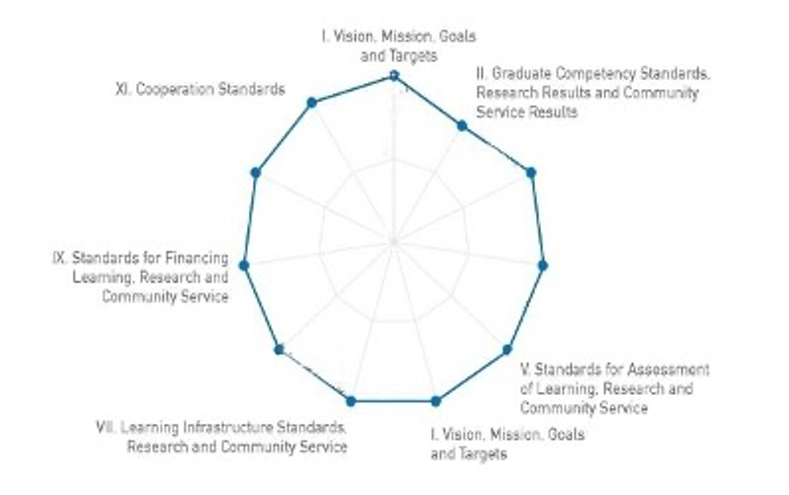
Figure: IQA Achievement of OGS program
The curriculum process is monitored and evaluated by monitoring and assessing the following aspects: (1) planning (course modules, teaching team preparation); (2) implementation (lecturer attendance, timeliness, alignment with course modules); and (3) evaluation of course implementation . This procedure was carried out throughout the semester. IQAED monitors this procedure once a year using an Internal Quality Audit (IQA). The most recent IQA results in 2022 are shown in Figure above. The results demonstrate that the attainment of the OGS programs is excellent in all standards except standard II, where OGS programs are satisfactory. The outcomes of the IQA evaluation will be addressed through meetings with study program leaders and faculty. These discussions will result in the development of corrective measures targeted at improving the situation. These measures will be implemented by the designated study program leaders, and their effectiveness will be evaluated at the subsequent IQA evaluation.
Leave a Reply